The Best Way to Find Local Events for Your Newsletter
Stop wasting hours searching for local events. Discover the most efficient ways to find, curate, and share local happenings with your subscribers.
The Best Way to Find Local Events for Your Newsletter
If you’ve run a local newsletter for more than a week, you know the "Sunday Scaries" aren't about your day job. They’re about the realization that you have to find fifteen interesting things for people to do by Thursday morning, and right now, your list is looking pretty thin.
I’ve been there. I have spent literal days of my life clicking through the fourth page of Google results, trying to find out if that one food truck is actually going to be at the park this Saturday or if that's a leftover post from 2023.
The truth is, most people find events the hard way (manual labor) or the "lazy" way (just copying the same three things everyone else is talking about). Neither of those is sustainable. In this post, I’m going to break down the "in the trenches" strategies for finding the best local events—and how to do it without losing your mind.
The Strategy of the "Deep Scrape"
Most events aren't hidden; they're just fragmented. They live in different "ecosystems" that don't talk to each other. To be the best newsletter in your town, you have to be the one who bridges these gaps.
1. The Institutional Calendars
Every town has "Anchor Institutions." These are the places that always have events, but their websites usually look like they were designed in the dial-up era.
- The Public Library: This is the goldmine for family events, workshops, and lectures.
- Parks and Rec Departments: Crucial for outdoor activities, sports, and seasonal festivals.
- Chamber of Commerce: Good for business networking and "main street" events.
The Pro Tip: Don't just check their websites. Subscribe to their their newsletters. Let them push the info to you.
2. The Social Media "Edge Cases"
Facebook Events used to be the only game in town, but that's changing. While Facebook is still important, you need to look at the "Edges":
- Instagram Locations: Look at the "Recent" posts for popular local venues (concert halls, breweries, community centers). People post flyers on their stories that never make it to an "Official Calendar."
- Nextdoor: Yes, it can be a toxic wasteland of "Did anyone else hear that loud bang?", but it's also where the hyper-local block parties and yard sales get posted.
- Reddit: Check your city's subreddit. Usually, there's a "What's happening this weekend?" thread that starts on Wednesday or Thursday.
3. The "Boots on the Ground" Method
This sounds like a lot of work, but it's high-yield. Spend one hour a week walking through your town's "Main Street" or "Arts District."
- Look at the physical bulletin boards in coffee shops.
- Look at the posters in the windows of bars and theaters.
- Often, these small, quirky events (poetry slams, underground jazz nights) only exist on paper posters. If you're the only one talking about them, you become "The Insider."

The Bottleneck: The Manual Labor Trap
Let's be real for a second. If you follow all the steps above, you will have a fantastic newsletter. You will also have a full-time job that pays you exactly zero dollars.
The "Manual Labor Trap" is what kills 90% of local newsletters. You start out with passion, but by month six, the thought of checking eighteen different library branches for "Story Time" schedules makes you want to throw your laptop out the window.
You need to move from Manual Scraping to Automated Scouting.
Why Automation is the Secret to Scaling
When I first discovered FluxLocal, it changed everything. I realized that 80% of what I was doing was just "Move Data from Point A to Point B." I was a glorified copy-paster.
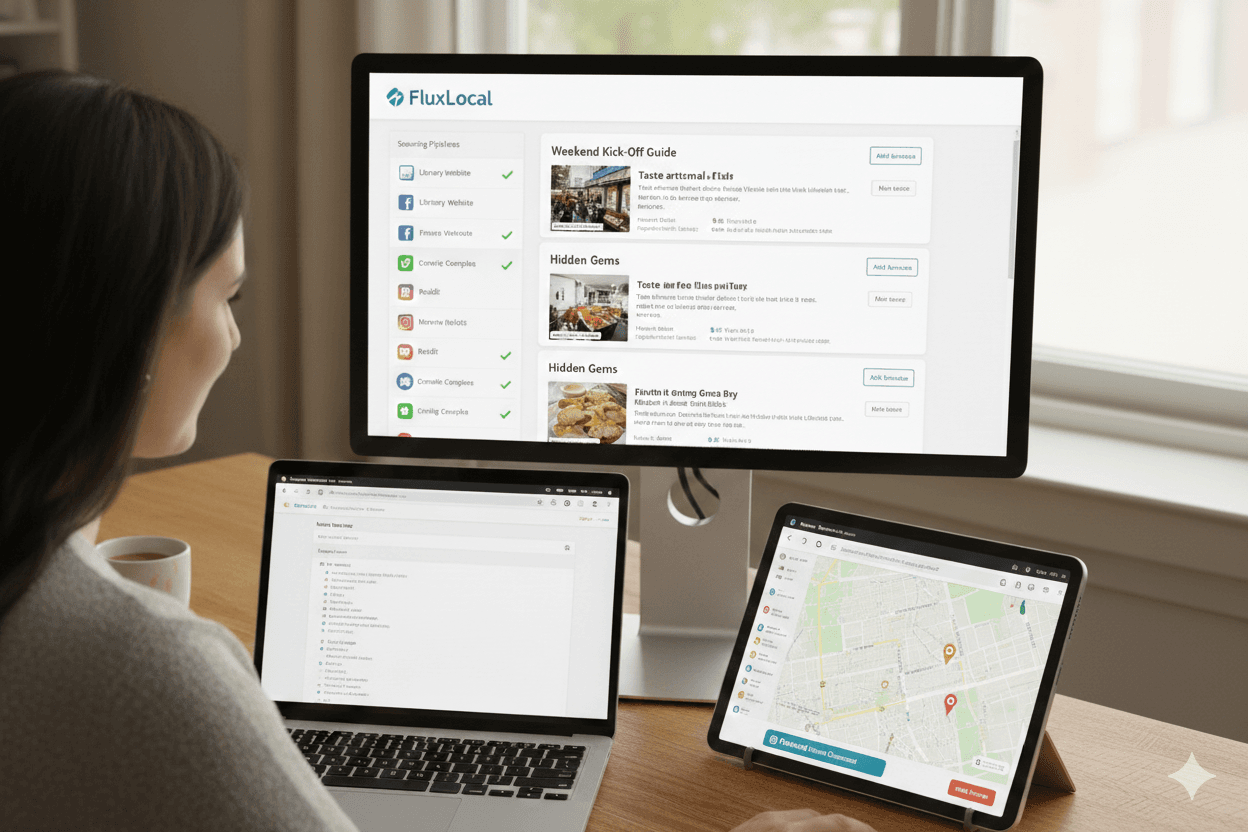
A professional-grade event discovery tool like FluxLocal does the heavy lifting for you. It "crawls" those institutional calendars, social media feeds, and event platforms, and brings them into a centralized dashboard.
Instead of searching for events, you transition to Curating events. There is a massive difference. Searching is a chore; curating is an art. When you have an automated feed of 100+ events in your town, your job is to pick the 10 that your audience will actually love. That's where the value is.
How to Curate Like a Pro
Once you have your "Master List" (ideally generated by a tool so you haven't wasted four hours finding them), how do you choose what makes the cut?
The "Variety" Rule
Your newsletter should never be one-dimensional. A perfect "Weekend List" includes:
- One "Big" Event: The thing everyone is going to be talking about (The County Fair, the big concert).
- One "Quirky" Event: Something unique (A fermented food workshop, a retro gaming night).
- One "Free" Event: Always include something for people on a budget.
- One "Family" Event: Something to do with the kids.
The "Ease of Use" Formatting
Don't just list the name of the event. Your readers are busy. Give them:
- The Hook: A one-sentence description of why they should care.
- The Logistics: Time, Location, and Cost.
- The Call to Action: A direct link to buy tickets or RSVP.
Developing a "Sourcing Pipeline"
To stop the "Sunday Scaries," you need a pipeline.
- Monday/Tuesday: Automated scouting (let your tools run and collect data).
- Wednesday: The "First Pass" (delete the junk, keep the gems).
- Thursday Morning: Writing and Formatting (the creative part).
- Thursday Afternoon: The "Final Polish" and scheduling.
By Friday morning, your newsletter is sitting in their inbox while you're drinking coffee, not frantically Googling "events near me."
Summary
Finding local events doesn't have to be a grind. It should be the most fun part of your week—connecting your neighbors to the things that make life in your town worth living.
The difference between a hobbyist and a professional newsletter creator is the System. Move away from manual searching as fast as you can. Leverage institutional knowledge, keep an eye on the "social edges," and use powerful automation like FluxLocal to do the grunt work.
Your time is better spent writing stories and building community than it is fighting with a library's CSS from 2004. Get the right tools in place, and you'll find that there is always something amazing happening in your town—you just have to be the one to find it.
Ready to stop searching and start curating? See how FluxLocal can automate your event discovery pipeline today.