AI-Powered Curation: Best Tools to Filter Regional Noise and Find Hyper-Local Gems
Learn how artificial intelligence is transforming how we discover neighborhood events and local businesses by stripping away regional digital noise.
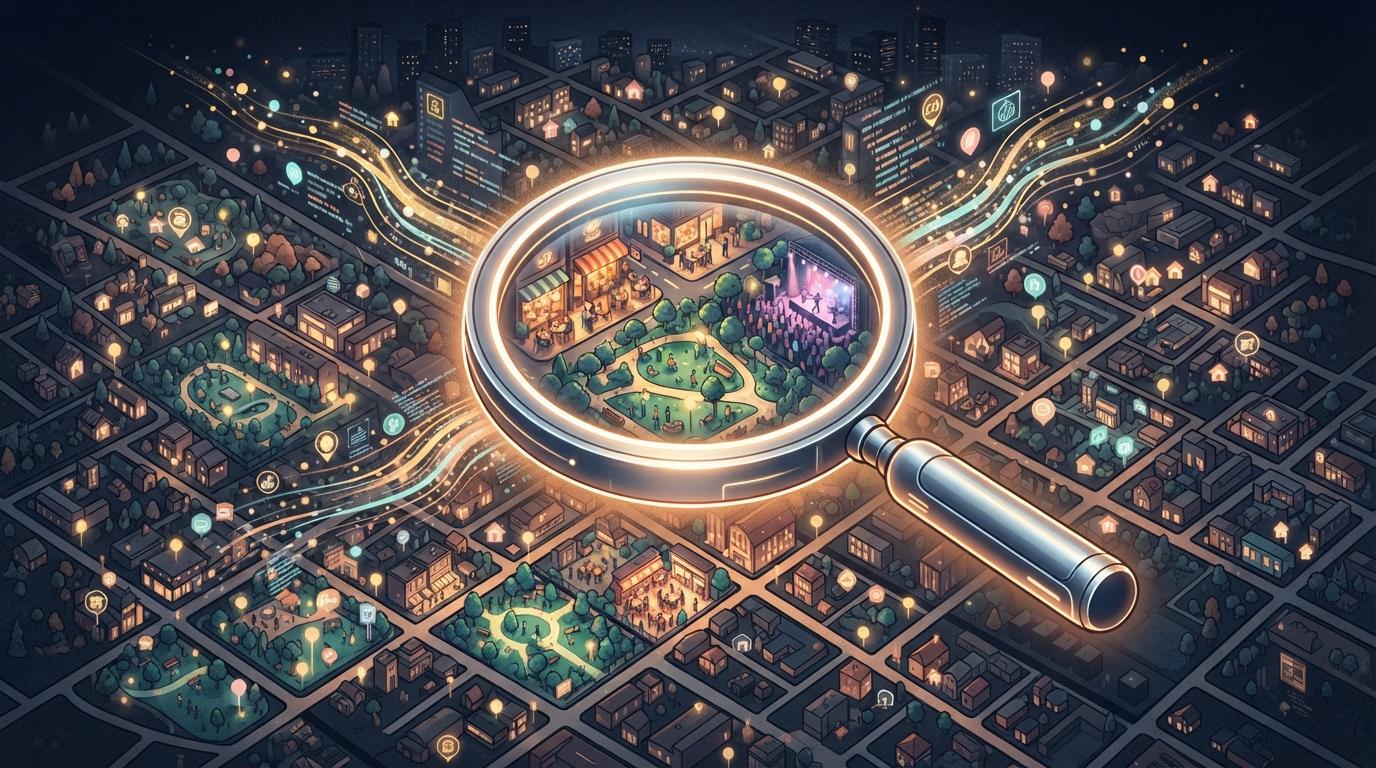
Imagine living in a bustling suburb just twenty minutes outside a major metropolitan area. You open your favorite social media feed or local news app, hoping to find something charming to do this weekend—perhaps a block party, a new artisanal bakery opening down the street, or a neighborhood yard sale. Instead, your feed is flooded with traffic reports from an interstate thirty miles away, breaking news about a city council debate in a town you’ve never visited, and sponsored ads for national chain stores located in a distant shopping mall. This is the reality of the modern digital landscape: regional noise constantly drowning out hyper-local signal.
For decades, digital platforms promised to connect us to our immediate surroundings. Instead, algorithmic incentives prioritized broad, high-volume engagement, bundling entire metropolitan zones into single, homogenous content buckets. The micro-stories, micro-events, and micro-businesses that actually define our day-to-day lives in our immediate neighborhoods end up buried under mountains of clickbait and regional updates. Fortunately, a quiet revolution is underway. Advanced artificial intelligence is shifting the focus from macro-engagement to micro-relevance, giving community members powerful new tools to filter out the noise and surface genuine hyper-local gems.
The Problem with Modern Local Information Pipelines
To understand why AI-powered curation is so necessary, we must first examine why traditional local media and first-generation social networks fail at the neighborhood level. The economics of content distribution have historically favored scale over proximity. A news outlet covering an entire county cannot afford to send a reporter to a local PTA fundraiser or highlight a family-owned shoe repair shop. Consequently, local media consolidated, widening its geographic coverage while sacrificing depth.
At the same time, legacy social media networks relied on user engagement metrics—likes, shares, and comments—to decide what content appeared in user feeds. Outrage, national political debates, and broad regional controversies naturally generate more comments than an announcement about a neighborhood book swap. As a result, algorithms systematically pushed true hyper-local updates down the page, replacing them with sensationalized regional or national stories.
The Rise of "Hyper-Local Digital Noise"
This structural bias creates several distinct problems for residents seeking connection with their immediate surroundings:
- Geographic Bloat: Content tagged as "local" often covers a radius of 30 to 50 miles, forcing users to manually filter out irrelevant information.
- Algorithmic Homogenization: Unique community voices are obscured by high-budget marketing campaigns from regional franchises and national brands.
- Information Fragmentation: True hyper-local information ends up scattered across obscure bulletin boards, paper flyers on lamp posts, specialized group chats, and fragmented social groups.
How AI-Powered Curation Changes the Paradigm
Artificial intelligence, particularly modern Natural Language Processing (NLP) and geospatial machine learning models, operates on a completely different paradigm than traditional engagement algorithms. Rather than asking, "What content will keep this user clicking for the longest time?", AI-driven curation engines ask, "What specific entities, places, and events are mentioned in this content, and how geographically precise is their relevance to this specific user?"
By processing unstructured data from thousands of disparate sources—ranging from municipal PDF filings and local club updates to social media posts and menu uploads—AI can categorize, verify, and geolocate information with sub-neighborhood accuracy. It converts chaotic, noisy text streams into structured, actionable hyper-local intelligence.
The Best AI Tools and Technologies Surfacing Hyper-Local Gems
A growing ecosystem of intelligent tools is helping urbanites, suburbanites, and rural residents alike reclaim their immediate surroundings. These technologies range from specialized consumer discovery apps to advanced backend curation engines.
1. Geospatial Natural Language Processors
At the foundation of modern hyper-local curation are advanced NLP models trained specifically on geographic entity recognition. Traditional search engines read a post about "Springfield Art Fair" and match it to the largest city named Springfield. Modern geospatial AI analyzes contextual clues—such as mentions of nearby cross-streets, landmark references, and local area codes—to map content to the exact neighborhood block where it belongs.
2. Intelligent Event Aggregators
One of the biggest pain points in community life is event discovery. AI-driven event engines automatically scrape, parse, and dedup calendar listings from community centers, independent venues, school boards, and library notices. By using machine learning to classify events into micro-categories (e.g., "Toddler-Friendly Outdoor Activities" or "Late-Night Jazz"), these platforms allow users to construct ultra-personalized local itineraries without wading through hundreds of irrelevant regional concert listings.
3. Micro-Business Sentiment and Discovery Engines
Finding local, independent businesses used to require scrolling through hundreds of generic review site ratings that were often dominated by tourists or out-of-town visitors. Next-generation AI curation tools analyze thousands of localized review fragments, local forum discussions, and community posts to highlight hidden culinary and retail gems. These tools look beyond raw 5-star ratings, evaluating specific semantic phrases like "favorite neighborhood spot," "hidden around the corner," or "community staple" to identify authentic local favorites.
4. Municipal and Community Noise Filters
Local government meetings, zoning updates, and public safety notices contain vital information about your immediate neighborhood, but reading through 80-page municipal agendas is impossible for most citizens. AI summarization tools now automatically process public sector documents, extracting changes that impact specific streets or zoning districts. Whether it is a proposed bike lane on your block or a park renovation down the road, AI distills complex municipal updates into clear, digestible neighborhood alerts.
Key Features to Look for in a Local Curation Platform
If you want to declutter your digital life and re-engage with your immediate physical community, not all local apps are created equal. When evaluating platforms and tools designed for neighborhood discovery, look for the following essential capabilities:
- Configurable Radius Controls: The platform should allow you to adjust your discovery feed down to a quarter-mile or specific neighborhood boundaries, rather than forcing a city-wide default.
- Semantic Content Categorization: It should understand the difference between a breaking news story about a highway multi-car pileup and a community update about a street closure for a farmers market.
- Privacy-Preserving Geolocation: Top-tier platforms deliver precise local recommendations without constantly tracking or selling your real-time GPS location data.
- Active De-Duplication: Powerful AI models cross-reference multiple posts about the same event or news item, presenting you with one clean, comprehensive update rather than five repetitive posts.
The FluxLocal Advantage: Transforming Neighborhood Discovery
While general-purpose AI tools offer fragments of local intelligence, dedicated platforms built from the ground up for micro-communities represent the true future of local curation. This is precisely where FluxLocal sets a new benchmark for community platforms.
FluxLocal combines cutting-edge machine learning models with human-centered community design to create an information ecosystem completely free from regional noise. Instead of relying on sensationalized engagement metrics that push clickbait into your feed, FluxLocal’s intelligent curation architecture prioritizes geographic precision and authentic local utility.
How FluxLocal Filters the Noise
By leveraging custom AI algorithms tailored for neighborhood-level dynamics, FluxLocal transforms how residents interact with their surroundings in several key ways:
- Precision Geo-Fencing: FluxLocal automatically parses incoming local updates, events, and community stories, assigning them to distinct micro-zones. You only see updates that directly affect your immediate neighborhood and chosen adjacent districts.
- Hyper-Local Gem Discovery: Through intelligent sentiment analysis and local recommendation processing, FluxLocal uncovers independent shops, popup markets, and home-grown community initiatives that traditional, broad-scale rating apps completely miss.
- Clutter-Free Community Feeds: By automatically identifying and grouping duplicate announcements and filtering out non-local regional ad campaigns, FluxLocal delivers a clean, quiet, and deeply relevant content feed tailored specifically to your daily life.
By bridging the gap between sophisticated data science and organic community building, FluxLocal ensures that you never miss a meaningful local moment simply because it was buried by an algorithm optimized for metropolitan drama.
Best Practices for Navigating Your Local AI Information Feed
Even with the best AI tools at your disposal, getting the most out of hyper-local curation requires a few simple user practices. You can train your local discovery feeds to serve you better by adopting these quick strategies:
1. Define Your True "Micro-Locality"
Take time to set your primary discovery zone to the actual area you walk or drive through regularly—typically a 1- to 3-mile radius around your home. If you want to explore another district, create a separate saved zone rather than expanding your primary radius to cover the entire city.
2. Provide Explicit Relevance Feedback
AI models learn rapidly from user feedback. When a platform surfaces a regional story that has no impact on your immediate area, mark it as "Not relevant to my neighborhood." Over time, the curation engine will refine its geographic filters to match your exact spatial preferences.
3. Mix AI Efficiency with Real-World Exploration
AI tools are ideal for surface discovery—finding that new coffee shop tucked away in an industrial park or uncovering a midweek acoustic set at a neighborhood park. Use AI as a springboard for physical exploration, and remember to contribute your own hyper-local discoveries back to the community feed to help your neighbors.
The Future of Hyper-Local Communities
We are moving away from the era of mega-platforms that treat multi-million-person media markets as single communities. The future of digital media is small, precise, and deeply rooted in physical place. As artificial intelligence continues to evolve, its greatest triumph may not be generating endless digital content, but helping us look away from global distractions and rediscover the rich, vibrant world right outside our front doors.
When technology strips away regional chatter, traffic complaints from three towns over, and generic corporate messaging, what remains is the true fabric of civic life: the independent business owners, the neighborhood volunteers, the local artists, and the vibrant events that turn a collection of houses into a real community.
Ready to tune out the regional noise and experience the real pulse of your neighborhood? Visit FluxLocal today to discover the hyper-local gems, events, and stories that make your immediate community unique.